

Food packaging buyers face a practical challenge: an additive that performs well in a laboratory must also work in the finished pack, protect the intended food, and meet the rules of its destination market. Zinc oxide (ZnO) attracts interest because it can contribute antimicrobial activity and UV protection, but those properties alone do not establish that a packaging formulation is effective or compliant.
Zinc oxide can be suitable for specific food-contact uses when the material, formulation, and conditions of use meet the applicable requirements. A food-grade label or promising nanoparticle study is only part of that assessment.
This guide explains how to evaluate zinc oxide in food packaging, from interpreting performance data and migration results to comparing grades and checking supplier documentation. The aim is to help procurement teams, QA managers, and formulators connect the evidence to the packaging they actually intend to manufacture.
Why Zinc Oxide Is Used in Food Packaging?
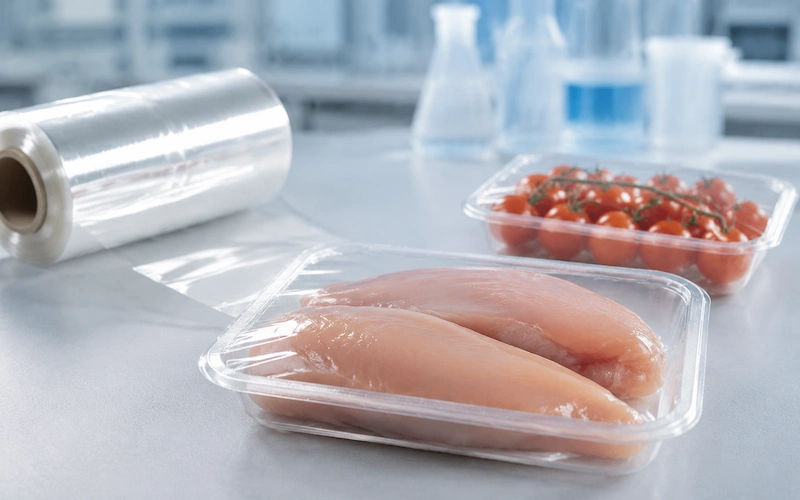
The appeal of ZnO is its potential to address more than one cause of food deterioration. Its contribution depends on how it is incorporated into the packaging and which problem the formulation is designed to solve.
Antimicrobial protection. Researchers have incorporated zinc oxide nanoparticles into films to investigate whether they can suppress bacteria at the food surface. Proposed mechanisms include zinc-ion release, interactions with microbial membranes, and reactive oxygen species generation. Their relative importance depends on the material and exposure conditions.
UV protection. ZnO can reduce the transmission of ultraviolet light through a film. For a packaging developer, the useful question is whether that change protects the particular food without compromising the pack’s appearance or other functions.
Support for shelf-life preservation. Antimicrobial and barrier effects can contribute to longer storage life in a tested packaging system. They should not be described automatically as oxygen scavenging or moisture removal: a material that slows transmission is performing a different function from one that actively consumes oxygen or absorbs moisture.
Research on gelatin-based films containing cellulose nanofibres and ZnO illustrates this combined approach. It investigated both film properties and chicken preservation, rather than treating the additive’s antibacterial behaviour as sufficient evidence on its own.
Advantages Depend on the Packaging System
For buyers, ZnO’s attraction is the possibility of combining optical and antimicrobial functions within one formulation. However, the comparison must include the complete manufacturing process: dispersion, coating compatibility, film formation, sealing, appearance, and performance after storage.
Do not assume that ZnO will outperform every organic antimicrobial, retain identical activity at every pH, or make a finished film heat-resistant. Ask suppliers to demonstrate the properties that matter to your production line and food product.
How Effective Is Zinc Oxide in Food Packaging?
Performance evidence is most useful when it answers a specific question. Inhibiting bacteria in liquid culture, producing an inhibition zone on agar, and controlling organisms on packaged food are different outcomes. None should be presented as interchangeable proof of commercial shelf-life extension.
Antimicrobial Performance in Real Food Matrices
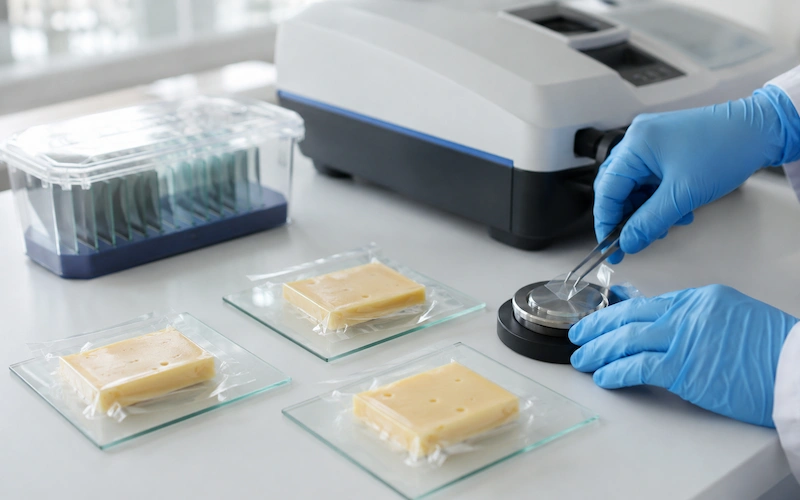
A study published in Scientific Reports tested ZnO/cellulose-nanocrystal/pectin films on artificially contaminated cheese stored at 7°C for five days. The active films reduced the growth of Staphylococcus aureus and Salmonella enterica compared with the study’s comparison films. The result supports further development of that particular formulation; it does not establish the same effect in meat, milk, produce, or a different polymer.
When evaluating a supplier’s antimicrobial claim, look for the organism tested, starting contamination level, control sample, storage conditions, and measurement method. A percentage reduction is difficult to interpret without knowing what was measured and when.
Shelf-Life Extension Data
The chicken study used gelatin/cellulose nanofibre films, abbreviated G/CNF. It evaluated ZnO additions of 1%, 3%, 5%, and 7% by weight relative to gelatin and selected 5% for the optimised system. These are experimental formulation details, not a universal loading recommendation for commercial films.
For your own trials, define the endpoint before claiming an extension: microbial acceptability, sensory quality, oxidation, or another relevant criterion. Compare the candidate with your current packaging under the same storage conditions. Any proposed change to the food’s labelled life should follow the product’s validation process.
UV Barrier Performance
The pectin-film study also found reduced UV transmission after incorporating ZnO, alongside changes in visible-light transmission. This illustrates a practical trade-off: protection and transparency should be evaluated together.
Request spectral transmission data for the finished film at its intended thickness. A statement such as “90% UV blocking” should specify the wavelength range, test method, and comparator. It cannot be transferred from one film composition to another without testing.
Choosing a Loading Concentration
There is no single ZnO concentration that guarantees effective antimicrobial food packaging. Begin with the permitted use and a defined performance target, then evaluate candidate loadings within that boundary.
Check the basis of every percentage. An addition expressed relative to dry gelatin or pectin is not necessarily the same as a percentage of the complete film or masterbatch. Trials should also assess dispersion and mechanical properties, rather than assuming that more additive always gives a better pack.
Is Zinc Oxide Safe in Food Packaging?
Safety depends on the specific substance, intended use, migration, and resulting exposure. Purity is important, but it does not replace the assessment of the finished food-contact article.
FDA Regulatory Status in the United States
Zinc oxide appears in 21 CFR §182.8991, within the GRAS provisions for nutrients, where its use is subject to good manufacturing practice. This is not a blanket approval for every antimicrobial packaging formulation or nano-ZnO product.
The FDA’s zinc oxide inventory entry also references §§175.300, 176.170, 177.1680, 177.2260, and 178.3297. The agency explicitly directs users to check the cited regulations for their intended application. A listing must be read with its restrictions, rather than treated as general permission.
Ask your regulatory team to document the legal basis for the exact use. If relying on an effective Food Contact Notification, confirm that its supplier and use coverage apply. FCC or USP conformity alone does not determine whether a separate authorisation is needed.
An antimicrobial intended to act in the food also requires careful classification: FDA’s definition of a food-contact substance excludes substances intended to have a technical effect in that food.
EU Regulatory Status
EU food-contact assessment includes the general framework under Regulation (EC) No 1935/2004 and the rules applicable to the material and function. Plastic packaging is subject to Regulation (EU) No 10/2011; active packaging also requires consideration of Regulation (EC) No 450/2009.
It is inaccurate to describe all nano-ZnO food-contact uses as awaiting approval. The EU plastics Union list includes uncoated zinc oxide nanoparticles, FCM No 1050, restricted to use in unplasticised polymers. This does not authorise every nano grade, polymer system, or antimicrobial application.
Check the exact entry, material specification, applicable migration restrictions, and intended function before selecting a formulation. Nutritional intake limits should not be substituted for packaging migration limits.
Regulatory Compliance Across Asia-Pacific
For export projects, use a destination-specific review rather than an “FDA/EFSA equivalent” statement. The following table identifies the questions to resolve; it does not certify ZnO approval in any market.
| Destination | What the buyer should verify |
| China | Which current food-contact material and additive standards apply to the substrate, ZnO form, loading, and intended function; whether additional authorisation is necessary. |
| Australia/New Zealand | Whether the complete packaging is suitable for the food and the storage or heating conditions under applicable requirements. |
| Japan | Whether the formulation falls within the synthetic-resin positive-list system and how its additive, coating, or active function is classified. |
| South Korea | Which current food-contact specifications apply and what evidence is required for the proposed ZnO material and use. |
| ASEAN markets | Requirements in each destination country, including Thailand, Indonesia, and Malaysia; do not use cosmetic rules as evidence for food packaging. |
FSANZ’s packaging guidance emphasises suitability for both the food and use conditions. Japan’s June 2026 positive-list Q&A distinguishes synthetic-resin raw materials from substances intended to migrate into and act on food. These are examples of why classification matters.
Migration and Nanoparticle Risks
Migration testing should distinguish, where relevant, between zinc transferred in dissolved form and the release of particles. A total-zinc result alone does not necessarily identify the form of the migrating material.
EFSA’s 2016 assessment considered a defined nano-ZnO use as a UV absorber in unplasticised polymers. Its conclusions concern that assessed material and exposure scenario, not all edible coatings or antimicrobial films.
For buyers, the next step is to match the test programme to the food, contact duration, temperature, and packaging construction. Zinc’s nutritional role does not by itself establish that additional exposure is harmless. Likewise, a laboratory hazard finding should be interpreted with the dose and likely consumer exposure, rather than used alone to declare a package safe or unsafe.
Zinc Oxide Grades for Food Packaging: Which to Choose?
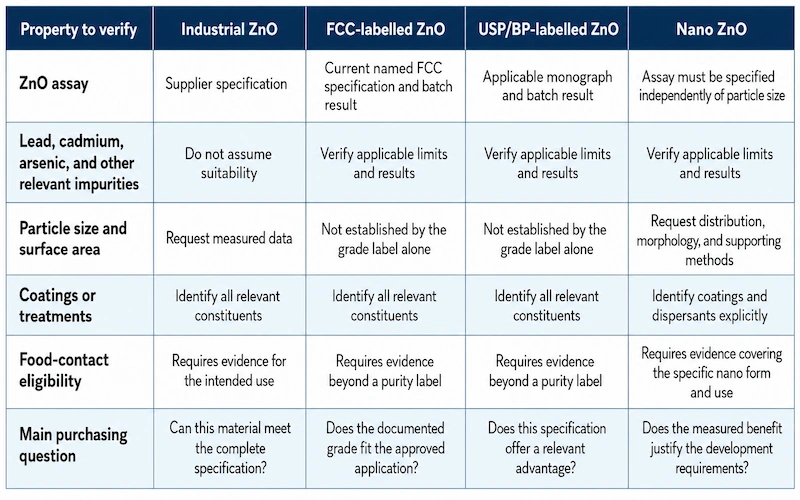
Once the intended use is established, grade selection becomes a specification exercise. A useful distinction is that purity grade and particle size describe different characteristics. “Nano” is not a higher step on a ladder from industrial to FCC to pharmaceutical grade.
Understanding Grade and Particle Specifications
Industrial ZnO should not be substituted solely because its ZnO assay appears similar. It needs the same application-specific evidence as any other candidate, including impurity control and a valid basis for food contact.
For material sold as food-grade zinc oxide, request conformity to the named standard and edition. For USP/BP material, obtain the relevant monograph results. Do not assume the standards are interchangeable or that pharmaceutical conformity automatically authorises packaging use.
Nano zinc oxide needs particle-characterisation information in addition to purity documentation. Coatings and dispersing agents must also be identified and considered in the intended use.
Matching the Grade to the Application
For a conventional film or paper coating, begin with the substrate, function, and destination market. Then compare candidate materials against the agreed purity, dispersion, and processing requirements.
For active packaging development, request evidence on the exact material proposed for trials. A smaller nominal particle size should not become a purchasing objective without a measurable benefit in the finished pack.
Glochem’s published BP/USP zinc oxide product information provides a starting point for a specification discussion. The page describes cosmetic and pharmaceutical grades; obtain written confirmation and supporting documentation for any proposed food-packaging use.
Zinc Oxide vs. Alternative Antimicrobial Packaging Materials
Compare candidates against the same brief: the food to protect, the failure mode to address, the manufacturing process, and the permitted use. A comparison based only on laboratory antibacterial activity can miss the reason a packaging formulation succeeds or fails.
Zinc Oxide vs. Titanium Dioxide
For an optical-protection project, compare measured UV transmission, visible opacity, dispersion, and compatibility in your actual film. For an antimicrobial project, require separate evidence of the intended microbial effect.
The EU’s withdrawal of titanium dioxide authorisation as food additive E171 should not be presented as a blanket ban on titanium dioxide in packaging. Food-additive and food-contact uses require their own regulatory assessment.
Glochem’s overview of how zinc oxide contributes to UV protection provides broader optical context. Packaging selection should remain tied to film testing and food-contact requirements, rather than borrowing conclusions from sunscreen applications.
Zinc Oxide vs. Silver Nanoparticles
Request equivalent performance and migration evidence for both candidates. Compare the required loading, supplied formulation, cost per finished pack, and regulatory coverage. Zinc’s status as an essential nutrient is not sufficient grounds to declare a ZnO system inherently safer than a silver-based alternative.
Zinc Oxide vs. Chitosan
Establish what role chitosan would play: film former, coating, antimicrobial component, or part of a combined formulation. Then compare moisture response, processing compatibility, mechanical performance, and food suitability. The materials need not be mutually exclusive, so evaluate the complete candidate structures rather than an abstract ingredient ranking.
Zinc Oxide vs. Essential Oil-Based Antimicrobials
For an essential-oil formulation, include sensory acceptance and retention during processing and storage in the trial plan. For ZnO, include appearance, dispersion, and migration. Both candidates need evidence for the actual food, rather than a general claim that one technology is more consistent or more natural.
Choosing Between ZnO and TiO₂
If UV protection is the main objective, prioritise the spectral data and appearance of the finished pack. If microbial control is the objective, prioritise food challenge testing. In either case, review the candidate’s permitted use before committing to reformulation.
Price comparisons should use quotations for the specified materials and include validation, processing, and quality-control costs. A fixed percentage premium for nano-ZnO is not a reliable budgeting assumption without supplier evidence.
How to Source Food-Grade Zinc Oxide: A Buyer’s Checklist
A useful supplier assessment turns the intended application into a set of documents and acceptance criteria. Before approving a purchase, work through the following checks.
- Define the application. Record the food types, contact layer, ZnO function, loading, storage life, and expected temperatures, including any heating or repeated use.
- Verify the specification and each batch. Obtain a certificate of analysis against the agreed standard, with relevant impurity results and test methods. Resolve any gaps between the purchase specification and the COA.
- Document the regulatory basis. Request an application-specific statement identifying the relevant authorisation or other legal basis, its limitations, and the markets it covers.
- Characterise the supplied material. Obtain particle-size and coating information. Ask what each measurement describes: primary particles, aggregates, or particles dispersed in a liquid. Do not treat different methods as interchangeable.
- Qualify the supplier. Review traceability, change-control procedures, manufacturing consistency, and the evidence supporting any certification claims. Agree when changes require notification or requalification.
- Run representative manufacturing trials. Assess dispersion, film appearance, sealing, mechanical properties, and the intended active function using the proposed production process.
- Validate the finished packaging. Obtain migration and performance evidence for the intended formulation and use. Agree on acceptance criteria, responsibilities, and the circumstances that trigger retesting.
Glochem also publishes information on its nano zinc oxide cosmetic and pharmaceutical grades. When discussing these materials, provide the complete packaging brief so the suitability assessment addresses the proposed use rather than the product name alone.
Storage Life of ZnO-Containing Films
The storage life of unused film is different from the shelf life of food packed inside it. Ask the film supplier to establish a storage period and conditions for the finished material, supported by the properties that must remain acceptable.
Include aged film in validation where appropriate. Do not assume a universal 12–24-month antimicrobial life: the relevant question is whether the stored film still meets its agreed specification when converted and used.
Conclusion
At Glochem, we see the value of zinc oxide in food packaging in matching a useful material to a clearly defined application. The strongest purchasing decision brings together appropriate grade selection, relevant performance evidence, and documentation for the finished pack’s intended use. By evaluating these elements together, we can have a more practical discussion about where ZnO fits and what needs to be demonstrated before commercial adoption.
Frequently Asked Questions
Does a supplier’s safety data sheet prove food-contact compliance?
No. An SDS supports safe handling and hazard communication. Request separate documentation addressing the intended food-contact use, material specifications, and applicable restrictions.
Is a packaging development sample suitable for direct addition to food?
Do not treat it as a food ingredient. Direct addition requires its own assessment of the intended use, purity, and regulatory basis; a packaging specification does not establish that suitability.
Can ZnO packaging replace refrigeration or hygiene controls?
It should not be used to bypass the food’s validated storage and handling requirements. Any proposed change needs evidence within the product’s food-safety system.
Can zinc oxide packaging be recycled?
Ask the relevant recycler or collection scheme about the complete packaging structure, including coatings and additives. ZnO content alone does not establish acceptance or recyclability.
Is it suitable for certified organic food?
Obtain confirmation from the relevant certification body for the exact packaging composition and intended function. Neither a food-contact statement nor a “natural” material description establishes organic certification compatibility.
What should happen if the supplier changes the ZnO coating or production process?
Request the change details and assess whether they affect the agreed specification, processing, performance, or compliance evidence. Decide whether requalification is needed before accepting the revised material.
